Costa Rica Travel Information |
|||
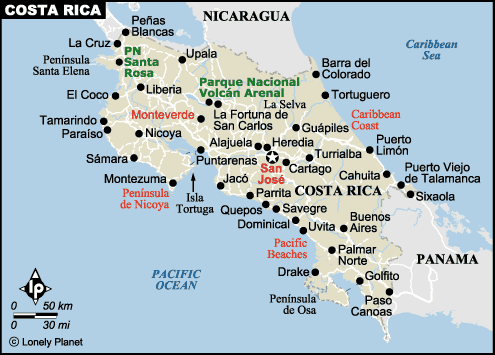
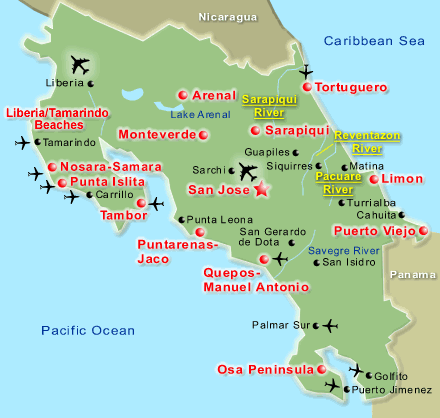
Find the best deals on accommodation at Costa Rica right hereArea: 50,895 square kilometers Population: 4,133,884 Passport: Required by all and must be valid Currency: Colon (CRC) Health: no special precautions Climate: The climate is tropical all year round however this varies depending on rainfall and elevation. Only about eight degrees north of the equator, the year can be split into two periods called Verano, which is summer and it doesn't rain and is between December and May. The other period is called Invierno, which is known as winter and it rains persistently between May and November. International Dialling Code: 011+506 Why Costa Rica?Costa Rica touches the heart and mind of the tourist, not through elegant boulevards, towering cathedrals, or imposing places in history but through its incredible natural beauty and gracious people disposed to please, who are full of kindness, and who have a generous spirit. With a national territory of 50,895 square kilometers, Costa Rica is slightly larger than Switzerland and it is the second smallest Central American country. But within the borders of this small country, you can find vast areas of jungle, countless streams and rivers, incredible diversity of wildlife and flora, amazing volcanoes and beautiful beaches. The natural beauty of Costa Rica is combined with the hospitality of its people, which underlies every facet of the country's tourist services. Costa Rica is one of the oldest democracies in the Americas (its first election was held in 1889) and the oldest in Latin America. Its history and political system, contrast with those of neighbor nations. In addition to this, the country dismantled its army in 1949 and it is perpetually at peace with excellent educational and health care systems. This political and economical stability has attracted many international organizations, such as the Interamerican Court of Human Rights, the Earth Council and the International Development Bank. Furthermore, this environment fosters long term planning for multinational corporations like Intel, Abbott, Baxter, Microsoft, Conair, etc. One of the Costa Rica's greatest assets is well-educated people. The literacy rate is more than 94%, and the country has one of the highest rates of college and technical school attendance in the world. Costa Ricans are also very much computer literate, and the country also has the highest ratio of computers in relation to people anywhere in Latin America. The money used previously in the army was destined to education and health care systems. Thus Costa Rica enjoys a life expectancy higher than 76 years, the student population is 25% of total, and the 95% of total population (3.5 millions) is covered by health care. As one of the world's top tourist destinations, Costa Rica also has a lot to offer in terms of modern facilities and hotel infrastructure. In this context, more and more companies are sending their star employees to Costa Rica for incentive vacations. Around the country you will find hotels in every price range, and a seemingly limitless variety of food to suit every taste. Accommodations range from luxurious, all-inclusive resorts to economical small hotels and cabins. Variety is what makes Costa Rica such an exciting country to visit. It is one of the most biologically diverse countries in the world, a treasure house of flora and fauna unequaled in so small area. About 25% of the country's area is protected as National Parks and Wild life Refuges. The national park system is complemented by a growing number of private protected areas. In Costa Rica you can find: breathtaking tropical beaches where you can swim, snorkel, dive, surf, fish and sea kayak. There are also clean rivers that range from white water rippers to tranquil jungle waterways; spectacular waterfalls; extensive haciendas and plantations; scenic mountains and rain forest; erupting awesome volcanoes and more. There is just a lot to see and do!!! In the same way, nature lovers enjoy Costa Rica because of its remarkable diversity of orchids, plants, birds, butterflies, mammals, fish, frogs, and other wild life. Casual tourist and dedicated nature traveler alike come under the spell of a natural wonderland. Costa Rica has something for everybody!!! Carribean Zone VI. Caribbean Coast Lim Tortuguero: The Caribbean coast offers amazing tropical rainforest, beautiful beaches and an abundant wildlife and vegetation. The wonderful Caribbean beaches have the special attraction of green sea turtles, which every year come to Tortuguero to lay their eggs. In addition, there are excellent eco-tourism opportunities, and plenty of activities for the adventurous, including fishing, sea kayaking, diving and much more. Tortuguero is one of the most popular destinations for nature lovers. This National Park offers canals, rivers, lakes, beaches and enchanting rainforest. The park also protects a wealth of exotic wildlife including those that gave its name: the turtle. Some other nice towns in the region are Puerto Viejo, Manzanillo and Cahuita where you can find miles of gorgeous beaches. Distances: San Jose to Lim 2.5 hours, San Jose to Puerto Viejo 4 hours, San Jose to Tortuguero 4.5 hours Things to do in this Caribbean paradise: · Beaches · Eco-tourism · Diving · Fishing · Surfing · Walking tours · Turtle nesting · Water canals · Biking · Local Caribbean culture · Tours from Lim Cahuita ·National Park & Puerto Viejo Gandoca Manzanillo ·Wildlife Refuge ·Biking & snorkeling in Punta Uva· Hitoy-Cerere Biological Reserve Central Zone I. Central Zone The Central Valley is the geographical, political and economical heart of Costa Rica. The most important cities of Costa Rica are located in Central Valley: San Jose the capital), Heredia, Alajuela and Cartago. Therefore, half of nation's population lives in this area. San Jose's a modern city, which offers a full range of accommodations, restaurants, shopping malls, museums and nightlife. It has a well-developed net of utilities such as drinking water, transportation and energy. Since the country's most important airport lies nearby, most of the visitors spend about three days of their Costa Rican vacation in the capital. At an altitude of 3,770 feet above sea level, the climate in San Jose's simply pleasant all the year around, which allows the tourist to enjoy its attractions. The city offers a wide variety of activities like city tours and tours to museums. Some of these museums are the National Museum that contains excellent history about Costa Rica, the Gold Museum, with an impressive collection of pre-Columbian jewelry, and the Jade Museum with the largest pre-Columbian jade in America. Another remarkable attraction is the National Theatre, an architectural jewel that recently celebrated its 100th anniversary. Beyond the capital, you can find smaller cities and traditional towns. Some important cities like Cartago offers attractions like the Basilica de Los Angeles, which is the site of a national pilgrimage every August second. Among the things to do around San Jose are the one-day tours such as the Rain Forest Aerial Tram at Braulio Carrillo National Park, volcanoes such as Iraz'd Po white water rafting and the town of Sarch where visitors will find souvenirs and handicrafts. Main Activities from the Central zone · Eco-Tourism · Rafting · Volcanoes · Golf courses · Meetings and incentives · Rain forest aerial tram · Museums and Culture · Fine Dining Tours from San Jose· City tour · Tour to Povolcano · Tour to Irazlcano · Rain Forest Aerial Tram · Tortuga island cruise · Lankester gardens and Orosi valley · Reventaz river rafting · Pacuare river rafting · Costa Rica Highlights · Tour to Sarapiqu · Sarch · Coffee tour Central Pacific IV. Central Pacific Puntarenas, Jacanuel Antonio, Dominical: This region holds exuberant tropical forests, beautiful beaches, an important number of protected areas and lots of wildlife and abundant marine life. The Central Pacific has abundant adventure spots and features ideal conditions for surfing, sea kayaking, horseback riding, hiking and bird watching. In ecological terms, the Central Pacific comprises an area of transition between the tropical dry forest of the North Pacific zone and the wet and rain forests of the Southern Zone. This region includes Manuel Antonio National Park, Carara Biological Reserve, Jaco beach, Hermosa Beach, Quepos and Dominical beach, among many other small towns and beaches. The Manuel Antonio National Park is one of the most famous of Costa Rica, due to its coastal scenery and amazing variety of flora and fauna. This area is also complemented by a diversity of hotels and restaurants for every budget. Distances: San Jose to Jaco 2 hours, San Jose to Quepos 3.5 hours, San Jose to Carara 1.5 hours What to do in the Central Pacific · Sun, sea and sand · Eco-tourism · Diving · Fishing · Surfing · Bird watching · National Parks Tours from Manuel Antonio: Manuel Antonio National Park walking tour Rancho Casa Grande Private Reserve "Pura Vida" Cruis Southern Pacific V. Southern Pacific Pensula de Osa, Golfo Dulce, Cocos Island: Down to the Peninsula de Osa you will find incredible beautiful beaches and virgin primary rainforests. Most of the peninsula is covered by the National Park of Corcovado. This remote area has wonderful eco-tourism opportunities. The South Pacific region of Costa Rica is one of the most important regions in Costa Rica, in terms of nature and bio-diversity. The best time to travel here is from January to April when there is little rain. This Corcovado National Park is the home to more than 400 species of birds and more than a hundred species each of amphibians and mammals and spans more than 40,000 hectares of protected land. Several habitats can be found inside its borders including montane and mangrove. Three hundred miles out to the sea you can find one of the most valuable treasures of Costa Rica: The Cocos Island. This densely vegetated and full of wonderful sea life island, was declared in 1997 by the UNESCO as World Patrimony by its natural beauty and biological riches. The island is also famous by its unique diving experiences. Distances: San Jose to Corcovado 5 hours, San Jose to Dominical 4 hours, San Jose to Golfito 7 hours What to do in this area? · Eco-tourism · Diving · Bird watching · Hiking · Adventure · Walking tours · Surfing Northern Zone II. Northern Zone Arenal, Sarapiqu Monteverde: This area is rich in rain forest, waterfalls, caverns, lakes, wild rivers, hot springs and the spectacular conical Arenal Volcano. You will also find an incredibly diversity of wildlife and flora. Rising 1,633 meters on the horizon, Arenal volcano is the most spectacular attraction of the region. The volcano rumbles regularly and bursts into occasional explosions that send molten lava and incandescent boulders flying in all directions. Near the volcano, the scenic blue waters of Arenal Lake complement one of the most amazing regions of Central America. Monteverde Cloud Forest Preserve is a forest reserve of 10,500 hectares and a popular destination for nature lovers. More than 100 species of mammals, 400 species of birds and120 species of amphibious and reptiles live within the boundaries of Monteverde. Distances: San Jose to San Carlos 3 hours, San Jose to Sarapiqui 2 hours, San Jose to Monteverde 4 hours, San Jose to Valle Escondido 2 hours. Things to do in San Carlos, Sarapiquamp; Monteverde · Volcanoes · Eco Tourism · Fishing in Arenal Lake · Bird Watching · Canopy Tour · Horseback riding tours · Hot springs · White water rafting and boat trips · Venado Caves · Wind surfing

|
|
Countries Antigua
|
|
|
|
|||